


Dissertation Guide
A dissertation is a detailed piece of academic writing grounded in extensive and original research. It is a crucial component of master’s and PhD programs, and in some cases, it can also be valuable at the undergraduate level.
Because of its complexity, many students struggle with writing a high-quality dissertation.
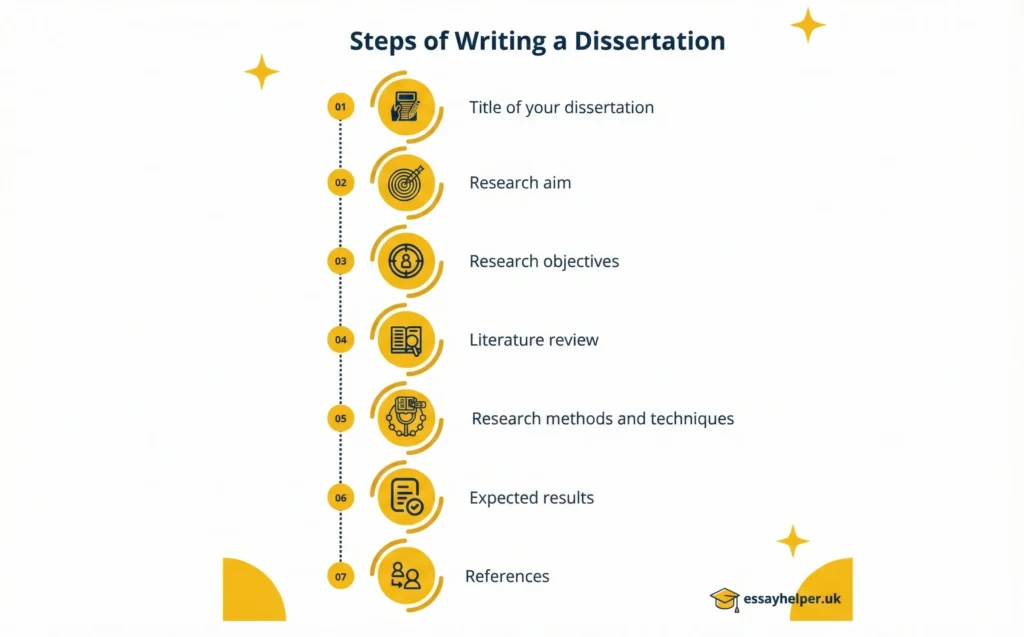
How to Structure a Dissertation
Title Page
Every dissertation begins with a title page, which typically includes your dissertation topic, your name, your institution, and the degree you are pursuing.
The format of the title page may vary; some universities may also require your student ID, supervisor’s name, or the university logo. It’s important to check with your faculty to ensure you follow the correct format for your dissertation.
Complete Guide: Dissertation & Thesis Acknowledgements
Acknowledgements
The acknowledgements section is where you can express gratitude to those who have supported or guided you throughout your research. Typically, researchers acknowledge:
- Supervisors or dissertation committee members who provided guidance and feedback.
- Advisors or mentors who assisted with specific topics or research challenges.
- Family members, such as parents, spouses, or siblings, for their encouragement and support.
Keep your acknowledgements concise and complete, for example:
Ideally, this section should not exceed one page.
How to Write a Dissertation Abstract
An abstract is a brief summary of your dissertation, typically 200 to 300 words, that introduces your research to the audience. It is one of the most important sections, as it helps readers quickly understand the essence of your work and encourages them to explore your dissertation in more detail.
It is recommended to write the abstract after completing your dissertation, as it should accurately reflect the entire study. A well-written abstract should include:
- The main topic of your dissertation
- The objectives of your research
- The methods used to conduct the study
- A summary of the results
- A brief conclusion
The abstract should be clear, concise, and engaging, giving readers a complete overview of your dissertation in just a few paragraphs.
“This dissertation examines the impact of remote work on employee productivity in the technology sector during the COVID-19 pandemic. Through a mixed-methods approach combining survey data from 150 tech professionals and in-depth interviews with 15 managers, the research identifies key factors affecting remote work productivity. Results indicate that while 68% of participants reported increased productivity when working remotely, challenges related to communication and work-life boundaries emerged as significant concerns. The findings contribute to understanding how organizations can optimize remote work arrangements and suggest practical strategies for maintaining productivity in distributed teams. This research has implications for post-pandemic workplace policies and provides a framework for evaluating the effectiveness of remote work implementation.”
Dissertation Contents & Lists: Complete Guide
Table of Contents
The table of contents helps readers navigate your dissertation with ease. It should list all chapter titles, section headings, and their corresponding page numbers. Creating a table of contents is simple in Microsoft Word, as it can be generated automatically if you use heading styles. Additionally, readers can click on any heading to jump directly to that section of the document.
List of Figures and Tables
Before creating these lists, it’s important to understand the difference between a figure and a table:
Table: A structured visual element that organizes information in rows and columns.
Figure: Includes diagrams, images, charts, or illustrations that support your text.
The list of figures and tables is a comprehensive compilation of all figures and tables included in your dissertation, along with their page numbers, making it easier for readers to locate them.
List of Figures
List of Tables
List of Abbreviations
An abbreviation is a shortened form of a word or phrase. For example, NASA stands for National Aeronautics and Space Administration. The list of abbreviations in your dissertation includes all the abbreviations used, arranged in alphabetical order for easy reference.
| Abbreviation | Full Form |
|---|---|
| AI | Artificial Intelligence |
| GDP | Gross Domestic Product |
| IoT | Internet of Things |
| NASA | National Aeronautics and Space Administration |
| WHO | World Health Organization |
Complete Reference Guide: Abbreviations List – Rules, Recommended Template & Example
Introduction
The introduction marks the official start of your dissertation. It follows the abstract and should be engaging enough to immediately capture the reader’s interest. The introduction provides a roadmap, giving readers a clear idea of what to expect in the rest of your dissertation.
Key Elements
The Scope of the Research
Define the boundaries and limitations of your study, clarifying what is and isn’t included in your research.
The Focus of Your Study
Explain the specific aspect or perspective your research examines within the broader field.
The Primary Research Question
State the central question that drives your investigation and that your dissertation aims to answer.
The Goals and Objectives of the Research
Outline what you aim to accomplish through your research and the specific objectives that will help you achieve these goals.
Note: Although the introduction is formally placed after the abstract, it is advisable to draft it early—even before writing the main chapters of your dissertation. This rough draft helps clarify your direction and ensures a cohesive structure throughout your work.
Glossary
A glossary is similar to a dictionary included in your dissertation. It contains all the technical terms, difficult words, or specialized vocabulary that readers might not be familiar with, arranged in alphabetical order.
- Algorithm
- A step-by-step procedure or formula for solving a problem.
- Analysis
- Detailed examination of the elements or structure of something.
- Bias
- A tendency, inclination, or prejudice toward or against something or someone.
- Bibliography
- A list of the sources referenced in a research paper.
- Correlation
- A statistical measure that expresses the extent to which two variables are linearly related.
- Criterion
- A standard on which a judgment or decision may be based.
- Data
- Facts and statistics collected together for reference or analysis.
- Deductive Reasoning
- A logical process in which a conclusion is based on the concordance of multiple premises that are generally assumed to be true.
Literature Review
The literature review provides a comprehensive understanding of your topic by examining existing research in the field. It not only summarizes previous studies but also serves as the foundation for justifying your own research.
A Well-Crafted Literature Review Highlights:
Step-by-Step Guide to Writing an Effective Literature Review
Collect Relevant Data
Gather research papers, articles, and other resources from credible sources such as journals, books, and Google Scholar.
Pro Tip
Create a systematic approach to organizing your sources using reference management software like Zotero, Mendeley, or EndNote.
Evaluate Sources
Assess each source for accuracy, authority, relevance, and currency.
- Check author credentials and affiliations
- Verify publication date and recency
- Examine methodology and sample size
- Consider journal reputation and peer review
Analyze Sources
Examine the historical development of ideas, theories, and methodologies presented in the research.
Draw Connections
Identify patterns, relationships, and gaps between studies through gap analysis and comparative evaluation.
Identify what’s missing in the current research landscape and how your study addresses these gaps.
Compare and contrast different approaches, findings, and methodologies across studies.
- Organize your review thematically rather than chronologically when possible
- Use critical analysis rather than simple description
- Maintain focus on your research question throughout the review
- Demonstrate how each source contributes to your understanding of the topic
Methodology
The methodology section of your dissertation explains how you conducted your research and arrived at your results. It demonstrates that your research methods are practical, reliable, and potentially useful for future studies.
Practical
Methods that can be implemented effectively
Reliable
Consistent and reproducible approaches
Reusable
Valuable for future research applications
Essential Elements of a Thorough Methodology
Research Approach
Describe the overall approach to your research, whether qualitative, quantitative, mixed methods, experimental, or theoretical.
Focuses on numerical data and statistical analysis to establish patterns and relationships.
Explores non-numerical data like interviews and observations to understand meanings and experiences.
The What, How, and When of Your Study
Outline the scope, procedures, and timeline of your research project.
What
Define the scope and boundaries of your research, including the specific questions addressed and variables examined.
How
Detail the procedures, protocols, and steps taken to conduct your research and collect data.
When
Provide the timeline and sequence of your research activities, including any significant phases or milestones.
Data Collection and Analysis Methods
Explain how you gathered information and the techniques used to interpret and analyze your data.
- Surveys and Questionnaires
- Interviews and Focus Groups
- Observations and Field Notes
- Statistical Analysis
- Thematic Analysis
- Content Analysis
Challenges or Obstacles Encountered
Discuss any difficulties faced during your research and how you addressed or mitigated these issues.
Tools and Materials Utilized
Detail the equipment, software, instruments, or other resources used in your research process.
Software
Analysis tools, data management systems, specialized applications
Equipment
Laboratory instruments, recording devices, specialized hardware
Resources
Reference materials, datasets, archives, repositories
Justification for Chosen Methods
Explain why your selected research methods are appropriate for addressing your research questions or objectives.
Effective Justification Includes:
- Connection to research questions and objectives
- Alignment with theoretical framework
- Consideration of alternatives and why they were not chosen
- References to similar successful approaches in the literature
Results
Primary Research Findings
The analysis revealed several significant patterns in the data collected. The primary finding was that 75% of participants demonstrated improved outcomes after the intervention, compared to the control group. This result directly addresses our first research question regarding the effectiveness of the intervention strategy. Statistical analysis showed this difference to be significant (p < 0.01), suggesting a strong relationship between the intervention and observed improvements.
Secondary Outcomes
Secondary analysis indicated that participant age was a moderating factor in intervention effectiveness. Specifically, participants between 25-34 years showed the strongest response (mean improvement score = 8.3), while those over 45 years showed more modest improvements (mean score = 5.7). Gender did not appear to significantly influence outcomes, with similar response patterns observed across all gender categories.
Correlation Analysis
Correlation analysis revealed a strong positive relationship between participant engagement levels and outcome measures (r = 0.72). This suggests that higher engagement with the intervention materials was associated with better outcomes, regardless of demographic factors. This finding supports our hypothesis that active participation is a key factor in intervention success.
Qualitative Insights
Qualitative data from participant interviews revealed three main themes: increased confidence, improved skill application, and enhanced problem-solving abilities. Many participants specifically mentioned that the structured approach of the intervention helped them develop more systematic ways of addressing challenges. As one participant noted, “I now have a framework I can apply to similar situations in the future.”
Research Challenges
Several challenges were encountered during data collection. Three participants withdrew from the study before completion, and some survey responses contained missing data points (approximately 3% of total data). These missing values were handled using multiple imputation techniques to maintain statistical validity. Additionally, one data collection session was interrupted by technical difficulties, potentially affecting the quality of responses for that particular group.
Note: In some dissertations, the results are combined with the discussion, while in others, they are presented as a separate section. Follow your institution’s guidelines or consult with your advisor about the preferred structure.
Discussion
Analysis of the data
Examining patterns, trends, and relationships.
Interpretation of the findings
Explaining the significance of the results.
Importance of the data
Highlighting how the findings contribute to the field and address the research question.
This section helps readers understand the broader implications of your research and the rationale behind your conclusions.
Conclusion
Answer the Research Question
Directly answer the primary research question
Summarize Research Outcomes
Summarize the main research outcomes and link them back to your objectives
Convey Main Argument
Clearly convey your main argument to the audience
Future Recommendations
Include recommendations for future research and final remarks
Reference List
In the UK, the most commonly used referencing styles are Harvard and Vancouver, while other popular styles include:
Appendices
This may include:
Final Tips
Practical Tips for Writing a Dissertation
Time management is one of the biggest challenges in dissertation writing. Many students postpone their work and later feel overwhelmed by the workload. Create a realistic timeline and stick to it to achieve better and more consistent results.
Maintaining a complete record of all your sources is essential. Since references must be included in your dissertation, organizing your sources from the beginning will save time and ensure accurate citations later.
If your supervisor is supportive and accessible, seek feedback regularly—especially before moving on to the next section. Early feedback helps identify issues sooner and improves the overall quality of your dissertation.
Your mental and physical well-being should always come first. Writing a dissertation can be demanding, so remember to take short breaks, rest when needed, and maintain a healthy balance throughout the process.
Frequently Asked Questions
- Introduction
- Literature Review
- Methodology
- Results
- Discussion
- Conclusion